
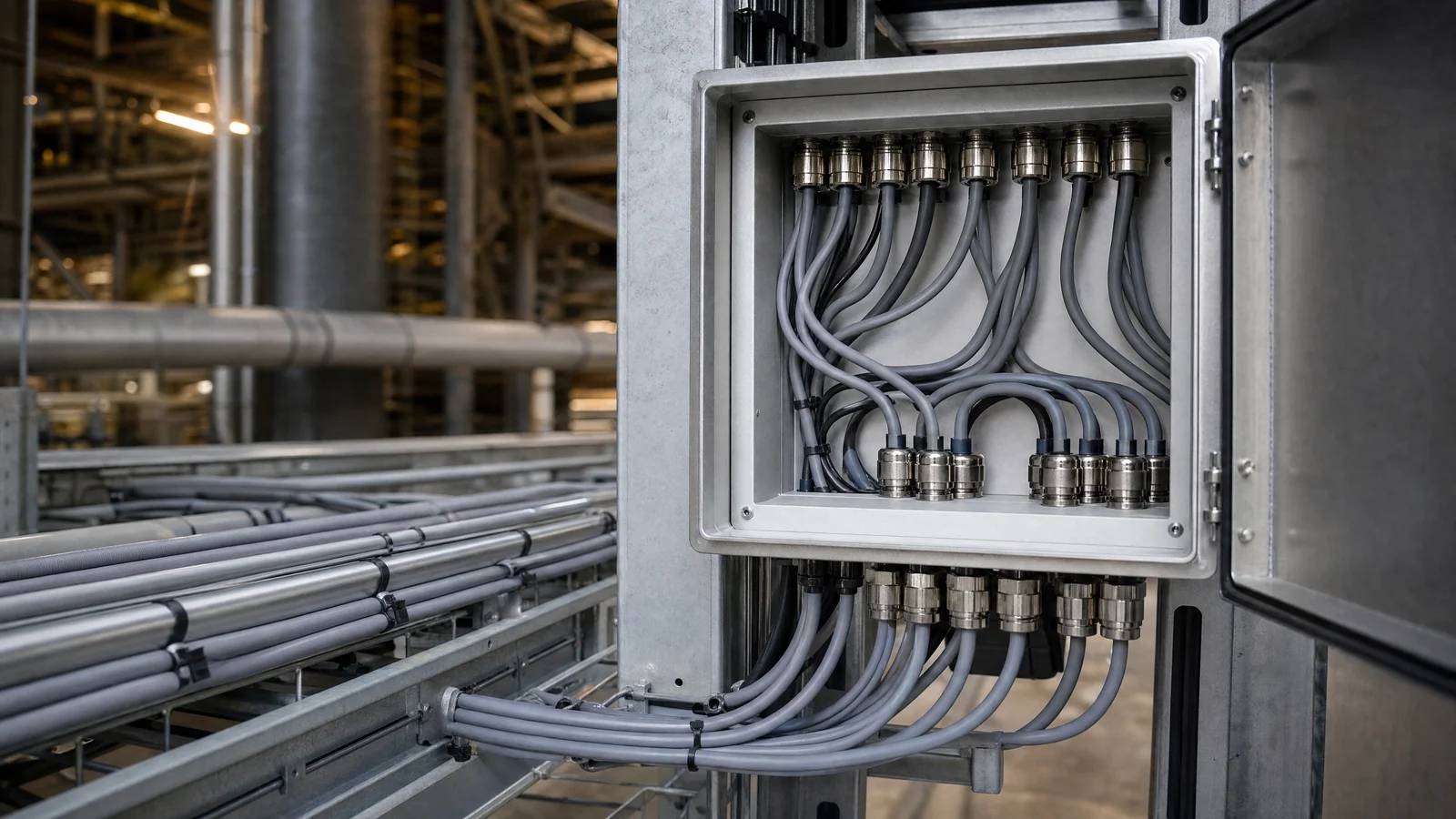
RD cables transmit measurement and control signals in industrial plants and power stations. Depending on the plant layout, connections run from field instruments through junction boxes to the control system. The appropriate cable version depends on the signal and installation conditions. This includes the choice of insulation and sheath materials: PVC or halogen-free compounds.
We offer RD-Y(St)Y Bd Eca and RD-H(St)H Bd Eca for these applications. Both use twisted pairs and an overall foil screen. Their differences include the insulation and sheath compounds and the available conductor sizes.
Inside an RD cable
The conductors are bare stranded copper. Four pairs form a bundle, with numbered tape identifying the bundles. Plastic-laminated aluminium foil surrounds the assembled cable core. A tinned copper drain wire forms part of the overall screen. Neither of these two types includes an additional copper braid.
An overall screen surrounds the pairs collectively. If the specification requires individually screened pairs, state that separately. An overall screen does not provide individual pair screening.
| Feature | RD-Y(St)Y Bd Eca | RD-H(St)H Bd Eca |
|---|---|---|
| Insulation and outer sheath | PVC | Halogen-free compound |
| Conductor size | 0.5 mm² | 0.5, 0.75 or 1.0 mm² |
| Overall screen | Aluminium foil with drain wire | Aluminium foil with drain wire |
| Signal frequency range | Up to 10 kHz | Up to 10 kHz |
The 10 kHz figure describes frequency. It does not establish a data rate in bits per second or suitability for a particular bus system.

Check the electrical requirements of the route
Pair count and conductor size alone are not enough to select a cable. Depending on the signal type, the loop resistance and capacitance of the entire connection also need to be considered. Both values increase with cable length. They must stay within the limits specified for the connected equipment and the transmission method. Include the planned cable length in your enquiry.
Electrical characteristics vary with the cable version and, for some properties, the number of pairs. Compare the measurement and control cable data sheets with the requirements of the connected equipment.
The test voltage is used to check the insulation under specified conditions. It is not a permissible voltage for continuous operation.
Installation conditions for PVC and halogen-free types
RD-Y(St)Y is intended for fixed installation, including outdoors, but not direct burial. Installing RD-H(St)H in soil or water requires a pipe that protects it from moisture. The pipe must provide that protection in practice; a pipe filled with water does not do so.
The versions described here have a reaction-to-fire classification of Eca. RD-H(St)H also has halogen-free core insulation and an outer sheath made from a halogen-free compound. The appropriate version depends on the project’s fire protection requirements. If circuit integrity during a fire is required, select a cable and installation system with separate evidence of that performance.
Preparing an enquiry
Include the cable type, pair count, conductor size and length, together with the signal type and connected equipment. Describe any sections indoors, outdoors or underground. For a replacement, attach the existing cable’s data sheet.
Send these details and the required fire documentation through our contact page. We can then check the cable against the requirements of your measurement circuit before you order.